Most people moving to Meridian expect ants. Maybe earwigs. A spider here and there.
Black widows don't usually make the list.
That's a problem, because black widow spiders are present throughout the Treasure Valley, including in Meridian neighborhoods. They don't announce themselves. They don't build webs across doorways or drop from ceilings. They find a dark, undisturbed corner and stay there, often for months, before anyone knows they're around.
Here's what Meridian homeowners actually need to know about black widows — where they live, when they're most active, how dangerous they really are, and what to do about them.
Are Black Widows Actually Common in Meridian?
Yes. More common than most people realize.
Idaho sits within the established range of the Western Black Widow, which is the species you'll encounter in the Treasure Valley. Meridian's climate — hot dry summers, mild winters, and abundant irrigated landscaping — suits them well. They don't require dense forest or wilderness. Suburban neighborhoods with wood piles, brick foundations, rock borders, and outdoor storage areas provide everything they need.
As Meridian has expanded outward along Ten Mile, Linder, McMillan, and beyond, new construction has pushed into land that was previously agricultural and undeveloped. That soil and surrounding terrain already supported black widow populations before the neighborhoods arrived. Construction doesn't eliminate them. It displaces them temporarily, and they reestablish in the structures and landscaping features of new homes relatively quickly.
If you've lived in Meridian for more than a year or two and haven't seen a black widow, you likely have them and simply haven't found one yet. That's not an alarm — it's just the reality of living in the Treasure Valley.
Where Black Widows Actually Live in and Around Your Home
This is the part that matters most for families.
Black widows are not active hunters that roam your house looking for people. They're ambush predators that build irregular, low-to-the-ground webs in dark, sheltered, undisturbed locations. They stay in one spot for extended periods once they've established a web. The problem is that those spots overlap consistently with where people reach, kneel, grab, or store things without looking first.
Wood piles are the most common harborage site in Meridian yards. A stack of firewood or lumber left on the ground provides exactly the dark, dry, protected environment black widows prefer. Reaching into a wood pile without gloves is the highest-risk activity most homeowners engage in regularly without thinking about it.
The underside of deck boards and patio furniture is another consistent location. Black widows build webs on the underside of horizontal surfaces close to the ground — the bottom of deck steps, the underside of outdoor chairs and tables, the gap between patio pavers and the ground. These webs get disturbed when people move furniture or sweep the patio.
Garage corners and wall voids near the floor are common interior locations. Garage storage areas with boxes, sporting equipment, and seasonal items sitting undisturbed for months are prime real estate for black widows. The spider that came inside in September may still be in the corner behind the holiday boxes in December.
Foundation plantings and rock borders along the house perimeter are high-density areas. Dense ground cover directly against the foundation, decorative rock mulch, and stacked stone borders all create the dark, sheltered conditions black widows favor. This is the zone that matters most for children who play in landscaping or along the edges of the house.
Outdoor play structures are worth checking every spring before kids start using them. The underside of platforms, inside slide tubes, and the connections where metal meets wood are spots black widows use for harborage. A structure that sat unused through winter may have one or more established webs by the time April arrives.
Identifying a Black Widow Web vs Other Spider Webs
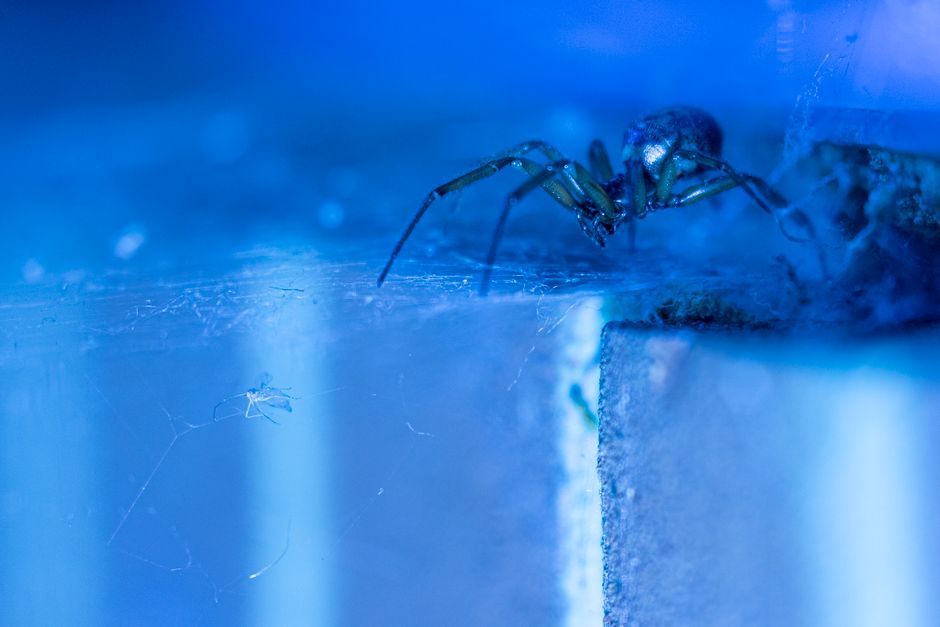
Most homeowners can identify a black widow by sight once they see one. The shiny black body with the distinctive red hourglass marking on the underside is unmistakable. But recognizing the web first is how you avoid reaching into the wrong spot.
Black widow webs are structurally distinct from the orb webs most people picture when they think of spiders. They're irregular, three-dimensional, and built close to the ground or surface. The silk is unusually strong and noticeably sticky — stronger than what most other common house spiders produce. The web often incorporates debris, dead insects, and egg sacs. It doesn't have the geometric precision of garden spider webs. It looks more like tangled, chaotic silk stretched between surfaces in a dark corner.
If you find a web that matches this description in a low, dark, undisturbed location around your home, treat it with caution before investigating further.
How Dangerous Are Black Widows to Meridian Families?
The honest answer is: more dangerous to young children and pets than to healthy adults, and more dangerous than most people assume in either case.
Black widow venom contains alpha-latrotoxin, a neurotoxin that triggers the release of neurotransmitters throughout the nervous system. In healthy adults, a black widow bite causes significant local pain followed by systemic symptoms — severe muscle cramping and rigidity, particularly in the abdomen and back, nausea, sweating, elevated blood pressure, and general distress. These symptoms can last 24 to 72 hours and are genuinely miserable but are rarely fatal in otherwise healthy adults with access to medical care.
In young children, the picture is different. The dose-to-body-weight ratio makes the same bite far more serious. A child under 30 pounds receiving a full venom dose from a black widow is in a significantly more dangerous situation than an adult in the same circumstance. Symptoms progress faster and more severely. This is not a situation where waiting to see how things develop is the right approach — a suspected black widow bite in a child is an emergency room visit, not a phone call to the pediatrician's nurse line.
Pets, particularly cats, are also notably sensitive to black widow venom. If your pet was in an area where a black widow was present and suddenly shows signs of muscle tremors, paralysis, or extreme distress, emergency veterinary care is appropriate.
When Are Black Widows Most Active in Meridian?
Black widow activity follows a predictable seasonal pattern in the Treasure Valley.
Spring, from March through May, is when overwintering females become active again and when egg sacs laid the previous fall begin hatching. This is when you're most likely to find them in wood piles and foundation areas that haven't been disturbed since fall. It's also the time of year when outdoor spaces get reopened after winter — exactly when play structures, patio furniture, and stored items get moved around without inspection.
Summer, from June through August, is peak activity. Black widows are most mobile at night during warm weather, and this is the period when they're most likely to be found in locations where families are spending time outdoors.
Fall, from September through October, is when black widows seek indoor harborage for winter. Garage entries, crawl spaces, and utility areas see increased activity as temperatures drop. This is when spiders that have been living outside all summer find their way inside.
The practical takeaway: inspecting the high-risk areas around your home in early spring, before the season ramps up, is the most effective timing for black widow prevention.
What to Do If You Find a Black Widow
Don't handle it bare-handed. That sounds obvious, but the most common black widow bites occur when someone grabs a piece of wood, a garden tool handle, or an outdoor item without looking and makes direct contact with a spider they didn't see.
If you find a black widow in an accessible location and want to eliminate it yourself, a direct application of a product labeled for spider control will kill it on contact. The more important step is checking the surrounding area for additional webs and egg sacs, which are white, papery, and roughly the size of a marble.
For anything inside the home, in a crawl space, or in areas with consistent black widow activity, professional treatment is the more thorough approach. Spider control in Boise and Meridian addresses both the active population and the perimeter areas where black widows establish harborage, reducing pressure before it reaches the spaces your family uses.
If a bite occurs, wash the area with soap and water, apply a cold pack, and seek medical attention. If a child is bitten, go to the emergency room without waiting for symptoms to develop. Bring a photo of the spider if you can safely get one — it helps the treating physician confirm the species and calibrate treatment. For questions about exposure, Poison Control at 1-800-222-1222 is available 24 hours a day.
Prevention: What Actually Reduces Black Widow Pressure Around Your Home
A few consistent habits make a significant difference in black widow activity around a Meridian home.
Keep wood piles elevated off the ground and stored away from the house. A wood rack that lifts the stack at least a foot off the soil and keeps the wood away from the foundation eliminates two of the conditions black widows prefer. Wear gloves every time you handle firewood or lumber, regardless of how unlikely a spider seems.
Pull ground cover and dense plantings back from the foundation. The direct contact zone between your landscaping and the house is the most productive harborage area on most properties. Keeping it clear and well-lit reduces the population building up immediately adjacent to the structure.
Inspect outdoor furniture, play structures, and stored items at the start of each season. A quick check of the underside of chairs, the bottom of deck steps, and the corners of any structure that sat unused for a few weeks takes a few minutes and catches most harborage before someone reaches into it unexpectedly.
Seal garage entries and crawl space vents in fall to reduce indoor harborage. Black widows entering for winter can be significantly reduced by addressing the entry points they use.
Consistent exterior perimeter treatment through residential pest control addresses black widow populations at the foundation and harborage zone before they establish at higher densities. As covered in our guide to pests common in new construction homes in Meridian , the soil around new Meridian homes often already has established spider populations before anyone moves in, making early preventative treatment particularly effective.
Frequently Asked Questions
Have black widows always been in Meridian or is this something new?
Black widows have been present in the Treasure Valley long before Meridian's growth period. They're native to the region and have historically lived in the agricultural land, desert margins, and rocky terrain surrounding what is now suburban development. As Meridian has expanded into that land, homeowners are encountering them in greater numbers simply because more people are living in and adjacent to their established habitat. The spider population hasn't grown — the human population moved into it.
What does a black widow bite feel like and how do I know if I was bitten?
Initial pain from a black widow bite ranges from a mild pinch to immediate sharp pain, depending on how much venom was injected. A small red mark may be visible at the site, sometimes with two fang puncture points. The distinguishing feature is what comes 30 to 60 minutes later — severe muscle cramping that radiates from the bite site, most commonly manifesting as intense abdominal rigidity and back pain. This is what separates a black widow bite from most other spider bites, which produce localized reactions without systemic muscle involvement. If you develop these symptoms after being in an area where a black widow could have been present, seek medical care.
Are the small black spiders I'm seeing in my Meridian home the same as black widows?
Probably not. Black widows are a specific species with distinctive characteristics — a shiny, jet-black abdomen with the red hourglass marking visible on the underside. Immature black widows and males look different from the adult female most people recognize. Many other black spiders live in and around Meridian homes without posing the same risk. The hobo spider is another species that generates concern in Idaho homes. If you're unsure what you're looking at, a photo sent to a pest control professional can confirm the species without requiring you to get close enough to examine it yourself.
Does Bigfoot treat specifically for black widows or just general spiders?
Both. The exterior perimeter treatment Bigfoot applies to Meridian homes targets the foundation zone and harborage areas where black widows establish at highest density. Targeted spot treatment can address specific locations where active black widow webs are found. Every treatment is backed by the Bigfoot guarantee — if spiders return between scheduled visits, so does the team at no charge. Get a free estimate to find out what a treatment plan looks like for your specific property.
Don't Wait Until Someone Gets Bitten
Black widows in Meridian are not a reason to panic. They're a reason to pay attention.
They live in predictable places, follow predictable patterns, and respond to consistent preventative treatment. The homeowners who end up in the emergency room are almost always the ones who reached into a wood pile without gloves, moved a piece of patio furniture without looking, or ignored a dark corner of the garage for a season too long.
A little awareness and a consistent treatment plan keeps your family's contact with black widows close to zero. Get a free estimate from Bigfoot Pest Control and find out what protection looks like for your Meridian home.
Contact Today For $100 Off Your Initial Service!
⭐⭐⭐⭐⭐
Backed by our Bigfoot Guarantee!
What Customers Are Saying:
"Everyone from Bigfoot is awesome. They are always on time. They're extremely thorough. I've not had a single issue in the two years they have been treating our home. Well worth it!"
T. Potter | Meridian, ID