You found it on a Saturday morning. Your kid almost grabbed the ladder rail, and there it is: a nest the size of a softball tucked under the platform, humming with activity.
The backyard just went off limits.
This is one of the most urgent calls we get from Meridian parents in summer, and the instinct is always the same: fix it right now, whatever it takes. That instinct is right. What matters is how you fix it, because the wrong move with a wasp nest on a play structure can turn a manageable situation into a trip to the emergency room.
Here's exactly what to do, what to avoid, and how to make sure it doesn't happen again next summer.
First: Don't Do These Things
Before getting into what works, let's cover what doesn't, because the most dangerous moments in wasp nest removal happen when a parent gets frustrated and improvises.
Don't spray it with a garden hose. Water doesn't kill wasps and soaking a nest makes them extremely aggressive. You will get stung, possibly many times, and the nest will still be there.
Don't knock it down with a broom or stick. Physically disturbing a nest without killing the colony first triggers an immediate, coordinated defensive response. The wasps don't disperse. They attack. A colony with several hundred workers can deliver dozens of stings in seconds, which is a serious situation for any child or adult nearby.
Don't let your kids near the structure until the nest is fully treated and removed. Even if you plan to call a professional, keep the play set off limits until the job is done. A nest that hasn't been disturbed is predictable. A nest that's been partially disturbed is not.
Don't treat it at midday. Wasp colonies are most active during warm daylight hours. If you're going to attempt any DIY treatment, timing matters significantly.
What You Can Do Yourself: Small Nests, Right Timing, Right Product
Here's the honest answer on DIY wasp removal: it's appropriate in some situations and genuinely dangerous in others. The deciding factors are nest size, nest location, and your ability to retreat quickly if things go wrong.
A small nest, roughly the size of a golf ball to a tennis ball, with a visible paper structure and fewer than 30 to 40 visible wasps, is within the range of a careful DIY treatment. A large nest, anything bigger than a softball with significant wasp activity, is better handled professionally, particularly when it's on a structure children use daily.
If you're going to treat it yourself, here's the approach that gives you the best outcome.
Wait until after dark. Wasps are largely inactive at night, and the majority of the colony is inside the nest. This is the safest window for treatment. Have a flashlight pointed at the nest before you approach, but stand to the side, not directly in front of the entrance.
Use a wasp and hornet aerosol with jet spray capability. Products designed for wasp nests project a stream of insecticide 10 to 20 feet, letting you treat the nest from a distance. Apply directly into the nest opening for several seconds, then move away immediately.
Wear protective clothing. Long sleeves, gloves, and eye protection are not optional. A face covering is worth adding if you have one. Being stung once while treating a small nest is possible even with proper timing.
Do not remove the nest immediately after treatment. Wait at least 24 hours. Wasps from outside the nest returning home will contact the treated nest surface and die. Removing the nest too soon leaves surviving forager wasps with no home and nowhere to go, which increases random aggressive behavior in the area.
If the nest is inside a void, such as inside a slide tube, inside a hollow play structure post, or inside a wall cavity adjacent to the play area, do not attempt DIY treatment. Void-nesting wasps cannot be effectively treated with aerosol sprays alone, and disturbing them inside an enclosed space significantly increases the risk of stings.
Why Swing Sets and Play Structures Are Wasp Magnets in Meridian
This is worth understanding, because most Meridian parents who deal with a wasp nest on a play structure end up dealing with one again the following year if nothing changes.
Wasps in the Treasure Valley begin scouting for nest sites in early spring, as early as March and April. Queen wasps that overwintered are looking for sheltered, protected cavities with good structural support. Play structures check every box. The underside of platforms provides overhead protection. Hollow posts offer enclosed cavity space. The structure is typically south or west-facing, which means it gets afternoon warmth. And in many Meridian backyards, the play set hasn't been touched since fall, so nobody has disturbed potential nest sites since the previous season.
New construction neighborhoods in Meridian compound this. Fresh eaves, unsealed wood, and new structures adjacent to undeveloped land give queen wasps an abundance of prime nest sites they haven't competed for before. If your play set went up in the last two or three years in a newer Meridian subdivision, wasp pressure on that structure is predictably higher than it would be in an older established neighborhood.
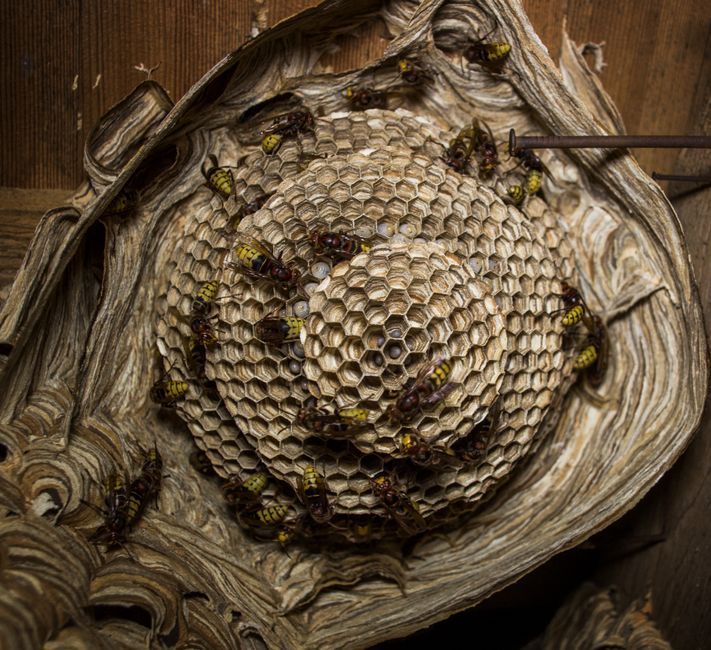
The species matters too. Paper wasps, yellow jackets, and bald-faced hornets all build nests in and around residential play structures, but they behave differently and require slightly different treatment approaches. If you want to understand the differences between the species you might be dealing with, our guide on wasps, hornets, and yellow jackets in Idaho breaks it down. Paper wasps build the open, umbrella-shaped nests most often seen under eaves and platform edges. Yellow jackets frequently nest in ground cavities, which can be invisible in lawn areas adjacent to play sets. Bald-faced hornets build the large, enclosed gray paper nests, often in shrubs or low-hanging branches near play areas.
When to Call a Professional
The situations that warrant a professional call are clearer than most people think.
Call a professional if the nest is larger than a softball. A colony that size has hundreds of workers and the defensive response to disturbance is proportionally larger.
Call a professional if the nest is inside a void or enclosed space in the play structure. Aerosol treatments are ineffective in enclosed spaces and disturbing a colony inside a tube or hollow post without being able to treat it effectively is a high-risk situation.
Call a professional if anyone in your household has a known venom allergy or has had a significant reaction to a sting before. The anaphylaxis risk from disturbing a large colony is real and doesn't give you much time to respond.
Call a professional if there are multiple nests. Finding one wasp nest on a play structure sometimes means there are others nearby that haven't been spotted yet. A technician will check the surrounding structures, eaves, and ground areas as part of the service.
Call a professional if it's July or August and the colony is fully established. Mid-to-late summer nests have had the entire season to grow and can contain over a thousand workers. This is not a DIY situation regardless of the starting nest size.
Wasp control in Boise and Meridian from a licensed technician includes treating the nest, applying residual product to the structure to prevent re-nesting in the same location, and checking surrounding areas for additional nests. The job that takes a homeowner significant risk and preparation takes a professional about 20 minutes.
After the Nest Is Gone: Preventing Next Year's Problem
Removing this year's nest doesn't prevent next year's. The same location that was attractive to a queen wasp this spring will be attractive to a different queen next spring, unless something changes.
Treat the play structure with a residual insecticide in early spring, before queen wasps start scouting. A product applied to the underside of platforms, inside hollow post openings, and around the connection points of the structure creates a treated surface that deters nest establishment before it starts. April is the right timing in Meridian, when temperatures are warming but queen activity is just beginning.
Seal hollow post openings with weather-appropriate plugs or caulk. Open hollow posts are one of the most common void nesting sites on residential play structures. Plugging them eliminates the enclosed cavity that wasps prefer for ground-level nesting.
Keep the area under and around the play structure clear. Dense vegetation, wood debris, and ground cover adjacent to the structure provide nesting opportunities for ground-nesting yellow jackets. Keeping a clear, regularly disturbed zone around the base of the structure reduces this pressure.
Inspect the structure every spring before the kids start using it. A five-minute walkthrough in early April, checking the underside of every platform and the interior of every hollow space, catches nests when they're new and small. A golf ball-sized nest with one queen is a very different situation than a softball-sized nest with 300 workers.
A quarterly residential pest control plan that includes seasonal perimeter treatment addresses wasp pressure around your home and structures as part of the regular service. The spring visit, timed for April in Meridian, is specifically designed to intercept wasp activity before colonies establish.
Frequently Asked Questions
How long does it take for a wasp nest to become dangerous near a play set?
Faster than most parents expect. A queen wasp starts building alone in April with a nest the size of a quarter. By June, the first generation of workers has hatched and the colony can have 50 to 100 workers. By August, a productive nest can hold 300 to 1,000 workers depending on the species. The critical window for easy removal is April through mid-May, when the nest is still small and the colony is limited. A nest discovered in July is already a significant risk, particularly on a structure children use daily.
Is it safe for my kids to use the swing set the same day a professional treats the nest?
The nest and immediate treatment area should remain off limits for at least a few hours while the product dries and any remaining forager wasps returning to the nest contact the treated surface and die. Your technician will give you a specific re-entry timeframe. By the following morning, the play structure is typically safe for normal use. The products used by Bigfoot are safe for kids and pets once dried, and the technician will confirm the timing before leaving.
What if I can hear wasps inside the play structure but can't see a nest?
This is a void nest, most likely inside a hollow post or enclosed section of the structure. Don't probe or disturb the area. Don't spray aerosol into the opening, as this can agitate the colony without effectively treating it. Call a professional. Void nests require specific treatment approaches that penetrate the enclosed space without triggering an aggressive defensive response from a colony you can't see and can't retreat from effectively.
Why do wasps keep coming back to the same spot on our swing set every year?
Wasps leave pheromone markers at successful nest sites. Even after a nest is removed, those chemical signals persist on the structure and attract new queens the following spring. This is why removing the nest alone isn't sufficient prevention. Treating the location with a residual product and physically altering the site, by sealing hollow openings or applying a deterrent, interrupts the cycle. Without this step, the same location will attract a new colony each spring until the site is made unattractive.
Get the Nest Gone Today
A wasp nest on a play structure is not a wait-and-see situation. Every day the colony grows, the risk to your kids grows with it.
Get a free estimate from Bigfoot Pest Control and get a licensed technician to your Meridian home, often same day or next day. The team handles everything from the nest treatment to checking for additional activity around your property, so you can hand the backyard back to your kids without second-guessing it.
Contact Today For $100 Off Your Initial Service!
⭐⭐⭐⭐⭐
Backed by our Bigfoot Guarantee!
What Customers Are Saying:
"Everyone from Bigfoot is awesome. They are always on time. They're extremely thorough. I've not had a single issue in the two years they have been treating our home. Well worth it!"
T. Potter | Meridian, ID